What AI sees in your Swiggy payout that you scroll past
AI checks every Swiggy deduction line — auto discounts, packaging, mystery refunds — before you see the PDF.
What AI sees in your Swiggy payout that you scroll past
AI checks every Swiggy deduction line — auto discounts, packaging, mystery refunds — before you see the PDF.
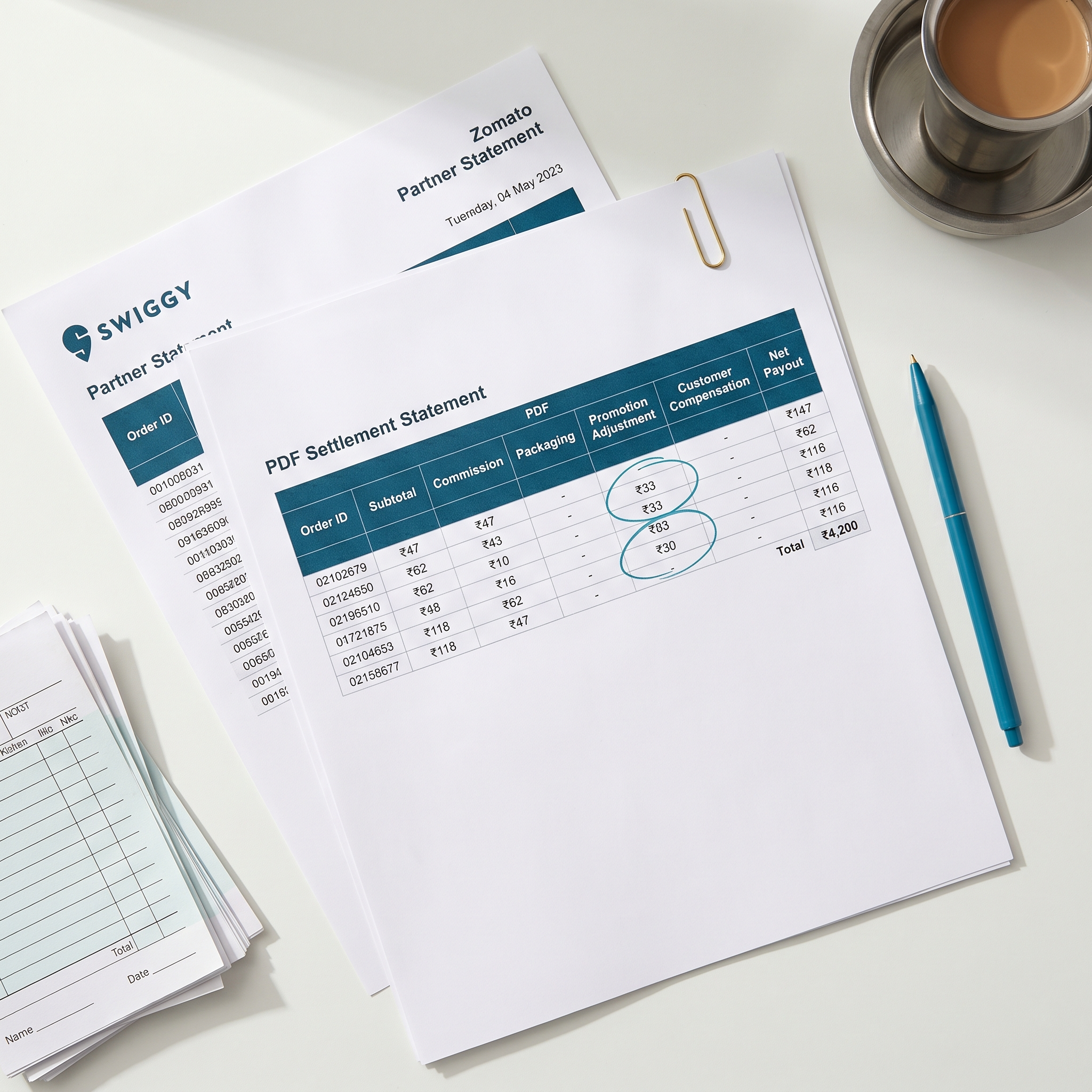
A Bengaluru restaurant chain on NH8 found ₹13 lakh in unauthorized auto-applied discounts sitting inside their Swiggy and Zomato settlement PDFs. They fought for nearly two years before getting a ₹10 lakh partial refund. Bamey's in Koramangala caught a single ₹80 auto-applied discount on one order — same mechanic, smaller number (newskarnataka.com). Both lived inside the same kind of weekly PDF you scroll past on Tuesday morning after Monday's dinner rush.
The thing that catches them — at week one, not month twenty-four — is not a sharper human eye. It is AI reading the settlement file the way a forensic accountant would, on every single order, every single week.
The ₹13 lakh problem: what "auto-applied discount" looks like in a settlement PDF
The mechanic is mundane. Swiggy activates a promotional discount on your listing. The competing aggregator mirrors it within 24 hours so neither side loses traffic. Neither platform turns theirs off until the other does. Your menu now runs at an effective 15-20% markdown that nobody on your team signed off on, and the deduction shows up as a small line item — "promotion adjustment," "platform offer," "merchant-funded discount" — on every order for weeks.
Open the PDF and it looks like a normal Tuesday payout. Subtotal, commission, packaging, taxes, net. Eyes glaze over by line 12. The discount line reads as ₹47 here, ₹62 there, ₹118 on the order with the family combo. Multiply by 80 orders a day × 28 days × two platforms, and you are quietly funding a markdown campaign you never approved.
The NH8 chain didn't catch it because someone read the PDF harder. They caught it because someone added up two years of those small numbers and the total stopped looking small.
What AI reads in a payout that the eye skips
When you paste a 7-day Swiggy or Zomato settlement export into Claude or ChatGPT — alongside your signed commission contract — AI doesn't read the file the way you read it. It computes the effective commission rate per order against the contracted rate, and flags every order where the gap exceeds a threshold you set. It does the same for packaging fees: contract says ₹8 per order, AI computes the actual per-order packaging deduction across the week, and tells you the average is ₹22.
It also reads the deduction codes that the eye treats as background noise:
- Auto-applied promotional discounts without a campaign ID in your approval log — flagged.
- "Customer compensation" or "customer refund" without a matching support ticket or return record on your end — flagged.
- "Ad spend" deductions without a campaign in your Swiggy Ads or Zomato Pro dashboard for that week — flagged.
These three categories — auto-discounts, mystery refunds, unauthorized ads — are the most-disputed line items in NRAI Bengaluru chapter complaints and the Outlook Business / Medianama coverage of aggregator deduction patterns. One six-outlet chain found ₹16 lakh deducted across its outlets between January and April with no notification, all of it sitting inside settlement PDFs nobody had time to audit (Medianama, April 2026). One owner publicly posted a Zomato weekly sales figure of ₹5,644.80 against a final payout of ₹0 (Postoast).
AI doesn't get tired at line 12.
How AI flags the line items that don't match the commission contract
This is the reconciliation step — the part of settlement reconciliation that humans treat as administrative drudgery and AI treats as a 30-second loop. The pattern recognition is what matters. Settlement audits done by hand catch the big number after it has been bleeding for months. AI catches the rate at which the rate is drifting.
Three weeks in a row, your effective Swiggy commission on biryani orders drifts from 22% to 24% to 25.4%. None of the individual weeks crosses a "huge alarm" threshold. But the trend line is what matters, and AI plots it for you the moment you connect last month's exports. The auto-discount that started as ₹47 per order ticks up to ₹68 next week and ₹91 the week after — because the competing platform finally matched, then over-matched. Your margin is being eaten in 50-paise slices, and the slicing accelerates the longer nobody disputes.
A human reading one PDF on one Tuesday morning will never see this. A system reading every PDF every Monday will see it on Monday two, and have it disputed before Monday three.
The dispute draft: what happens after AI finds the discrepancy
Finding the deduction is half the work. The other half is the dispute, and this is where most owners give up — because writing a clean dispute ticket with line-item proof takes an hour, and the hour doesn't exist between two billing rushes.
AI does the dispute drafting in the same pass:
- A support ticket addressed to your Swiggy or Zomato partner team, with the specific order IDs, the contracted commission rate, the computed effective rate, and the rupee delta — line item by line item.
- A timeline of the discrepancy across weeks — "your contract is ₹8 packaging per order; week of 19 May effective rate was ₹14, week of 26 May was ₹19, week of 2 June was ₹22; total disputed amount ₹4,200" — so the partner team can't ask you to "share more context."
- An escalation path if 72 hours of silence follows — a public tweet tagging the platform's care handle, an email to a sector reporter at Medianama or Outlook Business. The viral incidents work because the documentation already exists. Manish at Saffroma in Noida and Tulasi Nandan Addanki both surfaced their disputes publicly only after the support ticket went unanswered. The escalation isn't aggression; it's the documented fact pattern made public.
Counter-argument worth addressing: "my Swiggy account manager already resolves these." The account manager handles the case you escalate. AI finds the case across weeks and across outlets — the systematic pattern of ₹47 per order × 80 orders × 28 days, not the individual ₹4,200 refund. The chain-level pattern is what changes policy. The single ticket is what changes a single week.
AI watching every settlement week-on-week so you don't have to
The reason the NH8 chain bled for nearly two years is not that the owners were inattentive. It is that the work of running an Indian restaurant at dinner-rush velocity doesn't leave room for forensic PDF reading on Tuesday morning. The work of catching ₹47 per order across two platforms across 28 days is exactly the kind of work software was built for, and exactly the kind of work no Indian restaurant currently delegates because the existing toolchain — Petpooja, UrbanPiper, the partner apps — surfaces the PDF, not the audit.
The shift is small but it changes the floor. Every Monday at 6am, before the kitchen opens, AI pulls Swiggy and Zomato settlement exports, reconciles them line by line against your commission contract, and surfaces the three deductions worth disputing this week — with the ticket already drafted. By the time you finish chai at 9, you've already approved or rejected three disputes. The bleeding stops in week one. The drift never crosses ₹50,000.
That is the only durable answer to the "auto-applied discount trap" — not better PDFs, not better account managers, but a system that reads every week the way a forensic accountant would, and writes the dispute before you ask.
So what now
If you run a restaurant in India and your Swiggy or Zomato settlements arrive as a weekly PDF you scroll past, the work of catching auto-applied discounts, packaging adjustments, and mystery refunds is the kind of work a team of AI agents should be doing for you — every Monday before service starts — inside the WhatsApp thread you already use to run the kitchen.
That is what SideKyk is being built for: a team of AI agents living in your WhatsApp — an ops agent for settlement audits, a compliance agent for GSTR-1, a customer agent for review replies — so you don't open another app, you don't learn another dashboard, and you don't lose ₹47 per order × 28 days × two platforms before anyone notices.
We're opening the restaurants vertical to a waitlist first. Drop your WhatsApp number at sidekyk.ai/restaurants and we'll text you the moment your slot opens — and we'll run a free audit on your last 90 days of Swiggy and Zomato settlements as the first thing your ops agent does, before you decide whether to keep us.
Want this running in your WhatsApp every Monday morning?
Drop your number — we'll WhatsApp you the moment Restaurants goes live.
Join the waitlist on WhatsAppPowered by SideKyk · A team of AI agents in your WhatsApp